
Common Pain Points in Custom Jewelry Manufacturing Cooperation
What does the custom jewelry manufacturing process really look like behind the scenes? Many brand owners face repeated troubles during OEM and ODM jewelry customization.
The design sketch looks exquisite, but the sample produced by the factory does not quite match your expectations. The first batch turns out well, but the second and third batches start showing noticeable differences. The new product launch is set, but supplier delays cause you to miss the optimal sales window.
During communication with the factory, a simple question requires repeated confirmation, constantly extending the development timeline. If you are a jewelry brand owner, independent designer, or retailer, these problems are all too familiar.
Understanding the complete custom jewelry manufacturing process helps jewelry brand owners reduce development risks and pick a reliable silver jewelry manufacturer. You may also view our S925 silver OEM jewelry service to know more about our production capacity.
Many brands, when searching for a jewelry manufacturer, tend to focus only on price, MOQ (Minimum Order Quantity), or whether the product photos look impressive. In reality, the true value of a reliable jewelry manufacturer goes far beyond simply “making the product.”
A professional jewelry supplier must solve core production problems, including understanding your design philosophy, optimizing product structure, solving technical issues during production, ensuring consistent mass production quality, and guaranteeing on-time delivery.
A piece of jewelry goes through multiple complex stages from design concept to final retail product. If any stage is not properly controlled, the final product quality and appearance will be compromised.
Leiyuan Jewelry specializes in S925 silver jewelry OEM/ODM manufacturing services, providing global jewelry brands, designers, and retailers with one-stop solutions from product development and sample making to mass production. You can also browse our S925 silver custom jewelry pendant collection for finished piece reference.
Overview of the Complete Custom Jewelry Manufacturing Process
Many people simplify jewelry production into three steps: design drawing, production, and shipment. However, professional custom jewelry manufacturing follows a complete and standardized workflow with strict quality control at every stage.
The complete custom jewelry manufacturing process includes eight core procedures:
- Design communication and production feasibility assessment
- CAD modeling and sample confirmation
- 3D printing and wax pattern making
- Lost wax casting
- Sprue cutting, finishing, and polishing
- Gemstone setting
- Plating and surface finishing
- Full process quality inspection
Each step directly affects the product’s visual appearance, wearing comfort, durability, and batch-to-batch consistency. Understanding the complete production process helps brands accurately judge a factory’s real manufacturing capability before cooperation.
Key Industry Concerns for Custom Jewelry Production
Why Do the Same Designs Turn Out Different in Different Factories?
This is the most common problem in jewelry customization. The same design drawing may show different proportions, incomplete detail reproduction, misaligned gemstone positions, uncomfortable wearing experience, and unstable batch quality when produced by different manufacturers.
Jewelry manufacturing is not simple mechanical processing. It relies heavily on production experience and technical judgment. Professional factories fully analyze product structure, metal thickness, inlay firmness, deformation risks, and process difficulties before mass production.
For example, an overly thin ring shank in a delicate design will easily deform or break after mass production. Reliable manufacturers will optimize the structure in advance to avoid hidden quality risks.
Why Samples Are Perfect but Mass Production Quality Varies?
Sample production only produces one single piece with ultra-fine manual adjustment. However, formal bulk orders may include hundreds or thousands of pieces, bringing huge challenges to quality consistency.
Stable mass production requires unified production parameters, mature processing techniques, standardized inspection rules, and multi-stage product testing. Professional jewelry factories carry out quality control during casting, finishing, stone setting, and plating stages, rather than only checking finished products.
Benefits of Understanding Jewelry Manufacturing Processes for Brands
Learning the complete customization workflow brings long-term value to jewelry brand operation and supply chain management.
First, it reduces product development risks. Many failed new products result from untested production structures. Process verification helps brands avoid unmanufacturable designs, reduce repeated modifications, control costs, and shorten time to market.
Second, it improves batch quality consistency. For jewelry brands, stable mass production quality is far more important than a perfect single sample. Mature factories maintain unified standards through standardized processes and multi-stage QC inspections.
Third, it improves new product development efficiency. Experienced manufacturers accelerate the whole process from design communication, CAD development, sample confirmation to formal mass production, saving huge supply chain communication costs.
Fourth, it helps build long-term supply chain partnerships. Excellent jewelry manufacturers are not only suppliers, but brand growth partners who support continuous product iteration and line expansion.
Step-by-Step Custom Jewelry Manufacturing Workflow
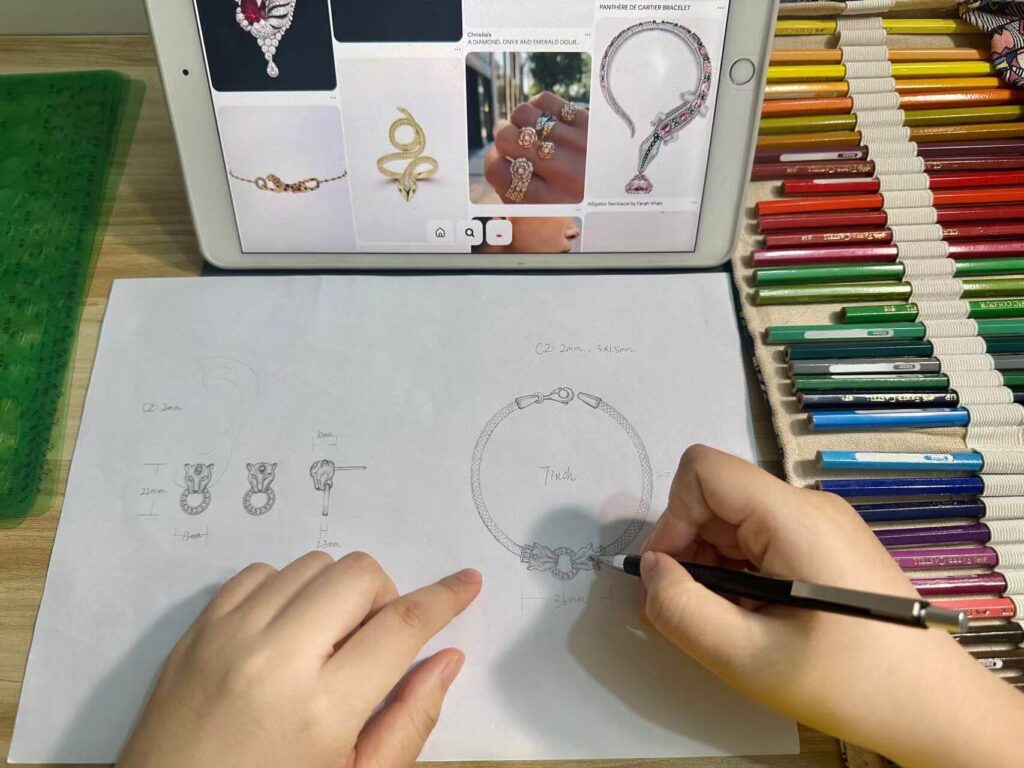
Step 1: Design Communication and Feasibility Assessment
Professional jewelry manufacturing starts with demand communication rather than direct production. Clients can provide hand-drawn sketches, reference photos, physical samples, CAD files, or brand design concepts.
Our professional team comprehensively evaluates product structure, metal thickness, gemstone setting methods, technical difficulties, cost control, and mass production feasibility.
Many perfect-looking designs on paper have hidden production risks, including unreasonable structures, insecure inlay positions, easy deformation, and excessive process difficulty. Early optimization effectively avoids mass production losses.
Step 2: CAD Modeling and Physical Sample Confirmation
After design assessment, our CAD team builds precise 3D digital models to confirm product dimensions, overall proportions, gemstone positions, metal thickness, and structural rationality.
After CAD file approval, we produce physical samples. The sample stage verifies gemstone specifications, production adaptability, style restoration degree, and wearing comfort. Formal mass production only starts after full sample confirmation.
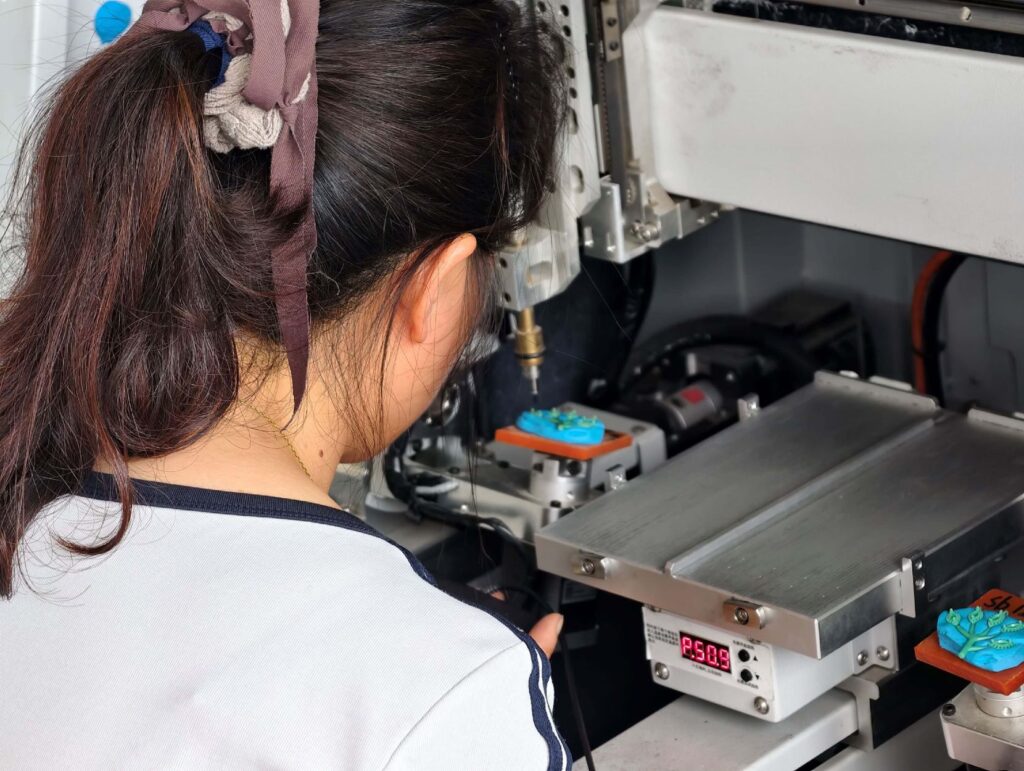
Step 3: 3D Printing and Wax Pattern Making
Based on confirmed CAD data, we adopt high-precision 3D printing to produce standard wax patterns. For bulk orders, multiple wax pieces are assembled into a complete wax tree for unified casting.
Wax pattern production directly determines casting precision. This step verifies dimensional accuracy, gemstone position correctness, and overall product presentation effect for mass production.
Step 4: Professional Lost Wax Casting Process
Lost wax casting is the core technology of silver jewelry manufacturing. The standardized process includes fixing wax trees in casting flasks, pouring refractory plaster, high-temperature wax burning, molten silver pouring, cooling, and blank demolding.
Precise temperature control is essential during casting. Unstable temperatures will cause pores, rough surfaces, lost details, and incomplete metal filling. Our factory relies on mature experience and standardized management to ensure stable casting quality.
Step 5: Sprue Cutting, Chasing and Polishing
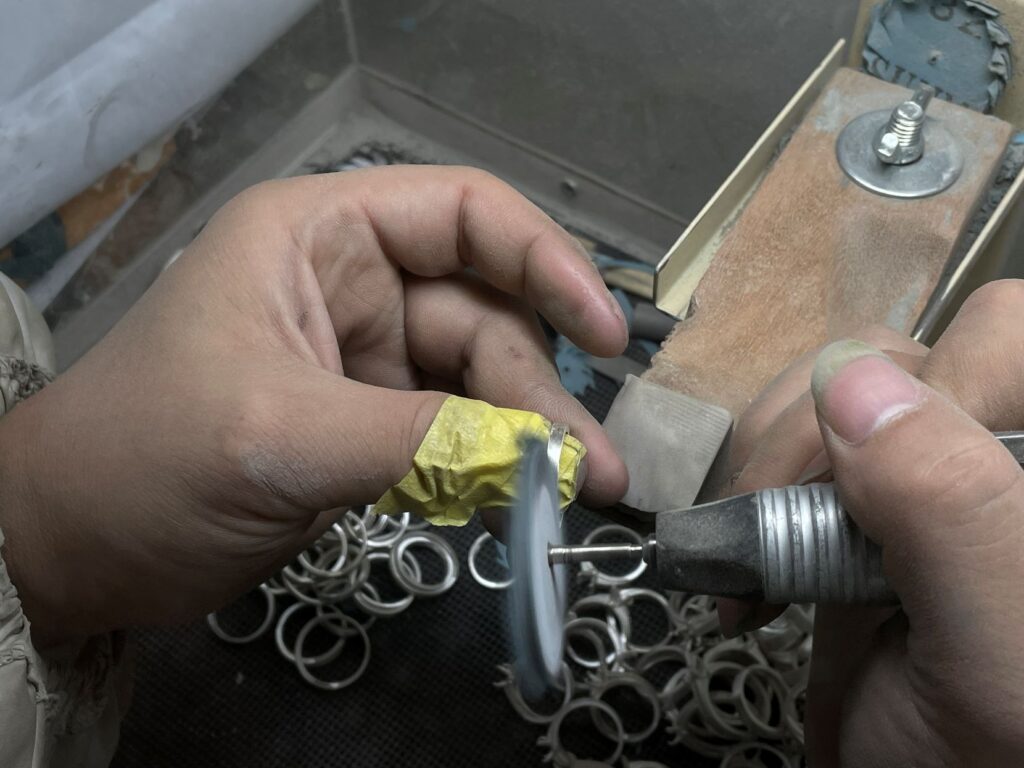
After casting, metal blanks need secondary processing. Workers first cut redundant casting sprues, then conduct professional chasing work to remove burrs, correct details, optimize lines, and repair structural defects.
Fine polishing is carried out finally to achieve uniform metal luster and smooth surface. Chasing and polishing heavily test craftsmanship. Unprofessional operation will cause thin walls, missing details, and irregular edges. Strict inspection is implemented after polishing.
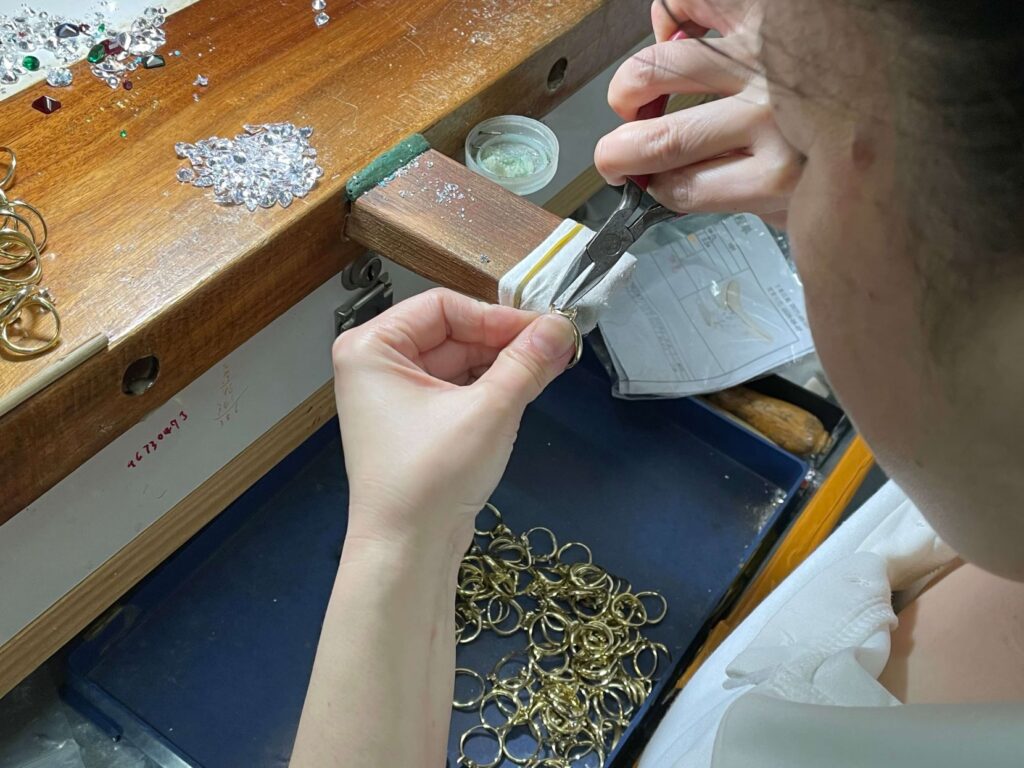
Step 6: Precision Gemstone Setting Process
We adopt targeted inlay methods according to different gemstone characteristics. For high-temperature resistant stones such as cubic zirconia and moissanite, we apply professional wax setting during the wax pattern stage.
Wax setting features high efficiency, unified batch standards, and low manual error. For heat-sensitive gemstones including emeralds and pearls, we adopt pure manual inlay after casting and polishing to protect gemstones from damage.
All finished inlays are strictly checked for firmness, precision, and overall visual harmony.
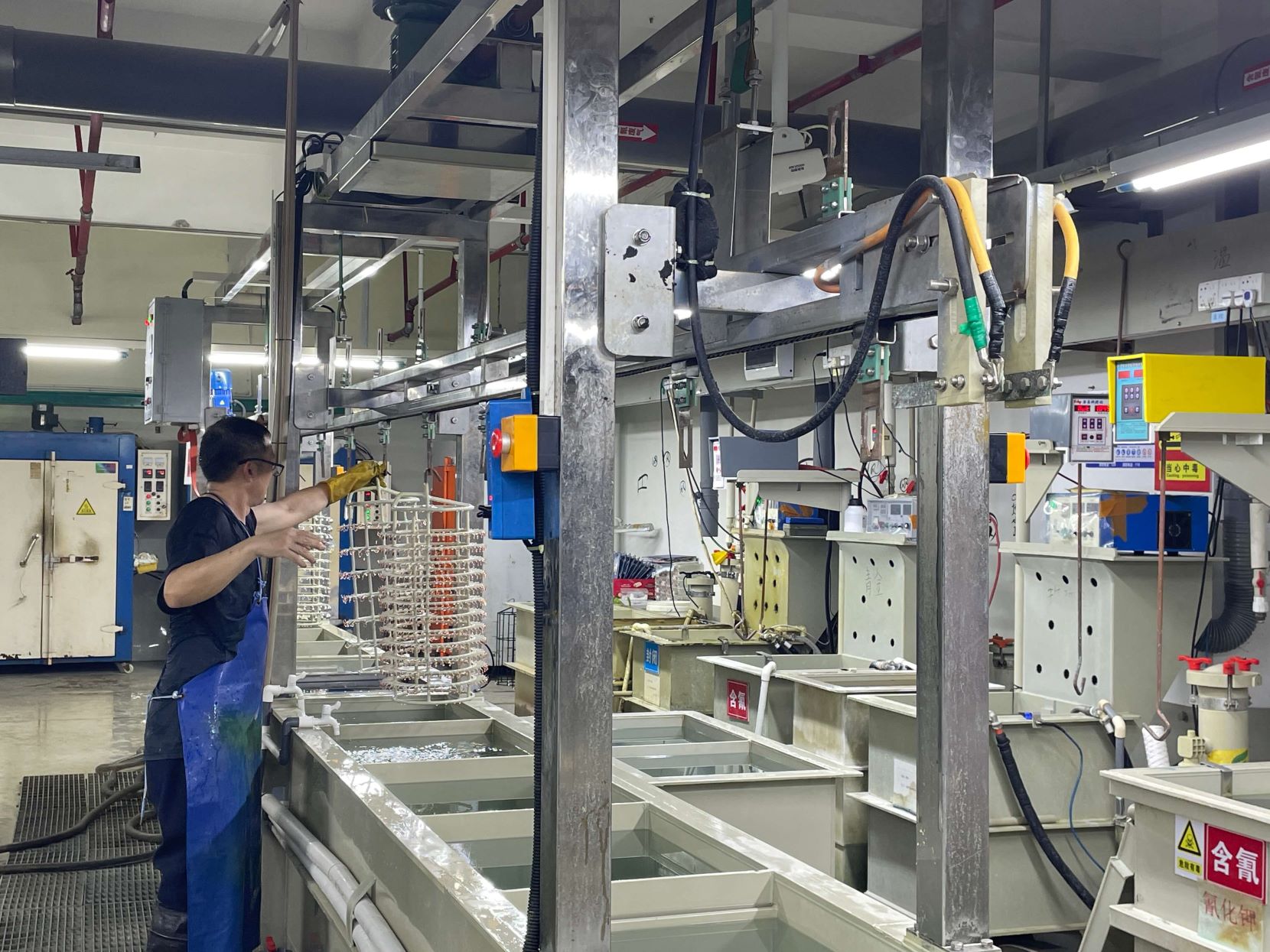
Step 7: Electroplating and Surface Finishing
Plating determines the final appearance, color texture, and wear resistance of custom jewelry. We provide rhodium plating, gold plating, rose gold plating and other customized surface treatments.
Pre-plating inspection is mandatory. Tiny scratches, pinholes, or polishing defects will be amplified after plating. Fine surface treatment ensures uniform color, bright luster, and durable oxidation resistance.
Step 8: Full-Process QC Quality Inspection
At Leiyuan Jewelry, quality control runs through the entire manufacturing process instead of only final shipment inspection.
During the casting stage, we check pores, cracks, and deformation. In the chasing and polishing stage, we inspect surface flatness, dimensional accuracy, and overall shape. In the stone setting stage, we test gemstone firmness, flatness, brilliance, and no cracking.
In the plating stage, we check color consistency, no oxidation, no black spots, and uniform coating. Before shipment, we conduct final inspection on product size, wearing comfort, stone firmness, and overall beauty to ensure all products meet export standards.
Real Custom Jewelry Manufacturing Cooperation Cases
Case1: Complex Structure Design Mass Production Realization
An overseas brand provided highly complex design drafts with structural production risks. Our team optimized CAD structures, adjusted unreasonable details, completed sample verification, and finally helped the client realize stable mass production of complex customized jewelry.
Case2: Solving Batch Quality Instability Problems
A long-term client faced inconsistent quality across different batches. We unified production parameters, added multi-stage intermediate inspections, and standardized operation processes, completely improving batch consistency.
Case3: Zero-to-One New Product Development Support
A new jewelry brand only had creative concepts without complete designs. We provided full services including design brainstorming, hand-drawn sketches, CAD modeling, sample trial production, and mass production docking, helping the brand complete product commercialization from scratch.
Conclusion: Choose a Reliable Long-Term Jewelry Manufacturing Partner
Custom jewelry manufacturing is not simple material processing. It requires professional design understanding, mature technical experience, stable production capacity, and complete quality management systems.
A professional S925 silver jewelry OEM/ODM factory effectively reduces brand development risks, stabilizes product quality, and supports long-term brand growth.
With 20 years of custom jewelry manufacturing experience, Leiyuan Jewelry provides one-stop customized solutions for global brands and designers. From design sketches to finished mass-production products, we strictly control every manufacturing procedure to deliver high-quality S925 silver jewelry.
Visit our about us page to learn more about our factory strength and OEM & ODM customization services.