Picking a sterling silver jewelry manufacturer decides more than your unit cost. It shapes your return rate, your launch calendar, and whether reorder three still matches shipment one. Yet many buyers still build a shortlist from catalog photos alone.
A good sample proves little on its own, because one skilled bench hand can build one excellent piece. Trust comes when a factory repeats that result across three hundred units, months later, from the same drawing.
So this guide lists exactly what we verify on our own floor. Use the same checklist on any supplier, including us.
What Counts as a Reliable Sterling Silver Jewelry Manufacturer
Photos and price tell you almost nothing at this stage. Start with five checks instead. Any real sterling silver jewelry manufacturer should answer these in writing, without a sales pitch.
1. Material you can prove, not just claim
S925 means 92.5% fine silver, and the rest is alloy added for hardness. Every supplier states that much. Far fewer will document it.
Ask for three things before any deposit. First, the base metal declaration. Then the refiner source, plus third-party nickel release test reports on request. Then ask about the finished piece, not only the raw silver. Plating baths and solder can both introduce nickel further down the line.
2. Craftsmanship that survives the whole run
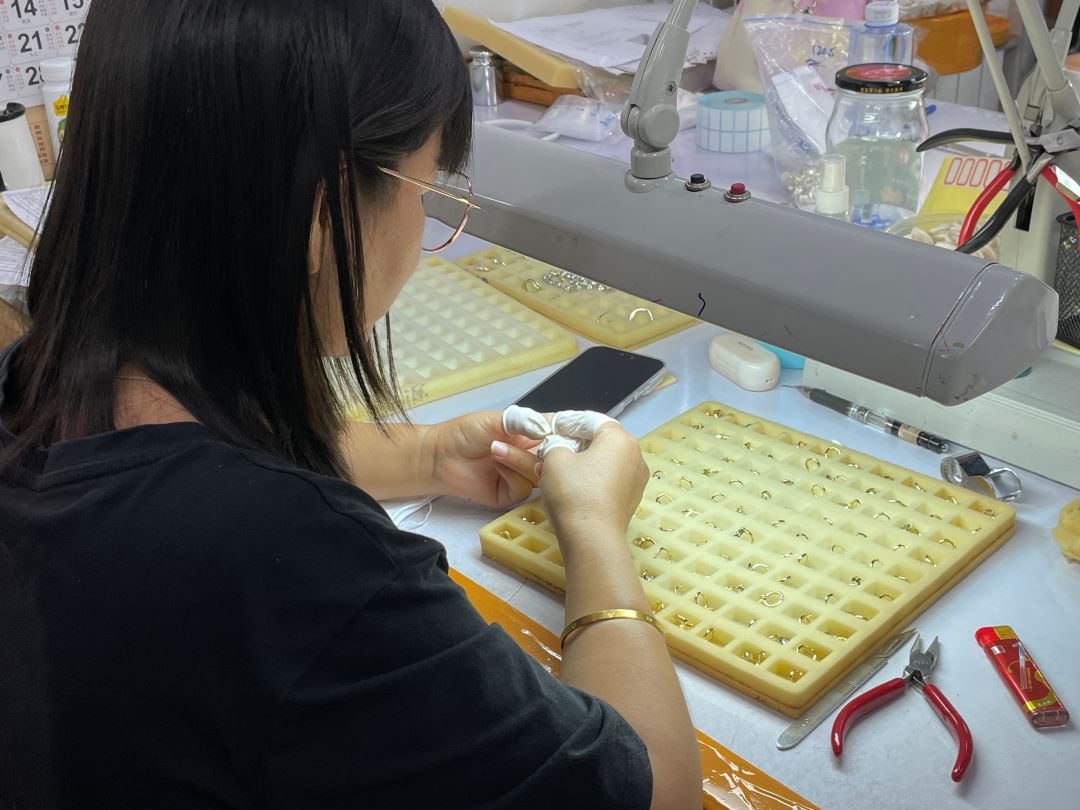
A finished piece passes through casting, filing, stone setting, soldering and polishing, and each stage can undo the last one. Here is one concrete case. Take a pavé ring: stones need even spacing, level seats and enough metal to burnish over each bead. If any of those three slips, stones loosen in wear.
Therefore ask when they re-check a setting, not whether they do. Polishing is exactly where weak prongs reveal themselves.

3. Plating spec written down
Gold, rhodium, black ruthenium and lacquer all behave differently, so ask for the layer structure in order. After that, ask for target thickness in microns and the method they use to measure it.
Now the honest part. Nobody can promise a wear-life without a thickness number and a stated test method. So treat any guarantee of “two years of color” as marketing when no micron figure stands behind it. Instead, ask for the stack, then test it yourself.
For reference, our own build runs silver, palladium, gold and lacquer in sequence. The palladium layer sits between the base and the top coat, which slows the diffusion that dulls plated metal.
4. Development range, not just catalog depth
Private label means CAD, wax, casting, stone sourcing, finishing and packing all have to talk to each other. Ask which steps run in-house and which move to a partner. Then ask who owns the quality call once a job leaves the building.
Branding deserves the same question. Most factories offer laser engraving, custom hang tags and custom packaging, yet placement rules differ by category. On a ring, the mark goes inside the band. On a necklace, it goes on the small oval tag beside the clasp. On earrings there is no fixed spot, so we normally mark the back. A supplier who cannot tell you where the mark lands has not done this at scale.
5. A quote you can actually audit
A usable quote separates silver weight, stone cost, setting labour, plating, sampling fees, packing and freight. If everything arrives as one unit price, you compare nothing. So you end up choosing blind.
Then settle the failure cases up front. Who pays rework after a failed inspection, and how fast do they answer a production question? Ask while you still have leverage.
The Numbers a Factory Should Give You Up Front
Any guide can list five principles. Because these figures differ between honest factories, here is what we disclose before you ask.
MOQ by category
Our minimum tracks tooling effort, so it differs by category. Rings start at 50 pieces per style. Pendants, necklaces, earrings, bracelets, anklets and sets start at 30 pieces per style. Each minimum covers one specification, so one style means one plating color.
Rings are the exception worth knowing. Because we run US sizes 5 to 10, you can spread those 50 pieces across the whole size run. There is no extra cost for that, so a first order stays one minimum, not six. Tell us the split you want, then we confirm what we can build.
Lead time
Two timelines apply here. Existing styles with no design change ship in 10 working days after order confirmation. Custom work takes 5 working days for a sample. After you approve it, bulk runs 10 to 15 working days.
Pricing structure
Silver moves daily, so we quote against the live silver price and run volume tiers. In other words, unit cost falls as quantity rises, and we publish no fixed list. Send target quantity plus plating choice, and we price it the same day.

Production model
We work made to order, so nothing sits on a shelf waiting for a buyer. We schedule the floor only after we confirm your order. Meanwhile your own specification is what gets built, rather than an existing design pulled from stock.
Samples: What to Check Before You Approve
A sample is a test bench, not a gift. So check it against a written spec, then write down what passed.
- Weight: Compare it against the quoted silver weight, since this is the first place cost gets cut.
- Dimensions: Measure stone diameter, band width and chain length, because renderings routinely flatter proportions.
- Setting: Run a fingernail across each stone; anything that catches is a future return.
- Finish: Check plating tone under daylight rather than showroom light, since warm lamps hide yellow drift.
- Hardware: Open and close clasps twenty times, then check posts and joints for play.
- Comfort: Put it on. A piece that catches on a cuff will not sell twice.
Comparing Quotes Without Getting Burned
A lower price is rarely a discount. It usually hides one of these differences, so make every supplier declare them.
- Silver weight, which drives most of the cost.
- Stone grade and cut, since the same CZ comes in several price tiers.
- Plating thickness, because this is where the largest silent saving hides.
- Sampling and mould fees, which some quotes bury and others waive.
- Packing level: poly bag, pouch, or retail box.
- MOQ per style, and whether sizes or colors count separately.
- Payment terms and what happens to nonconforming goods.
QC Points to Agree Before Production Starts
Inspection before shipment catches defects once they already exist. Agree these checkpoints instead, so problems surface while they are still cheap.
- Incoming materials: Confirm metal spec and inspect components before casting.
- Casting: Check structural integrity, porosity and dimensions.
- Stone setting: Verify alignment, seat level and prong security.
- Polishing and plating: Confirm surface quality and lot-to-lot color consistency.
- Final inspection: Check appearance, dimensions, function and packing count.
- Sampling plan: Agree the acceptance criteria and the rework route in writing.
FAQ
How do I tell a real manufacturer from a trading company?
Ask one specific design question and listen to the answer. A manufacturer talks about tooling, shrinkage and setting sequence, because those are daily problems. A trading company talks about catalogs and lead times instead. Neither model is wrong, but only one can change your stone layout mid-development.
Can you send material and nickel release reports?
Yes, on request. We build on S925 sterling silver, stamped S925, and the metal is nickel-free and lead-free. So we can also send third-party nickel release test reports when your market requires documentation.
What is your MOQ for custom work?
Rings start at 50 pieces per style, while other categories start at 30. The minimum covers one specification, so one order carries one plating color. Size is the exception: on rings you split those 50 pieces across sizes as you like. Laser engraving rides along with the bulk order, so it adds nothing to the minimum.
How long does development take?
Sampling takes 5 working days, then bulk production runs 10 to 15 working days after you approve the sample. Existing styles need no sample, so they ship in 10 working days from confirmation. All quoted times are working days and exclude shipping.
Does the gold plating fade?
Every plated finish does eventually, so the useful question is how fast and under what conditions. Because we have no thickness figure to publish here, we quote the layer stack instead of promising a duration. Tell us your market and wear conditions, and we will recommend a build.
Do you hold stock?
No, and that is deliberate. We are the source factory, so we produce to order and nothing sits in a warehouse. Therefore styles stay open to your plating and sizing requirements rather than arriving as finished goods.
Final Word
Choosing a sterling silver jewelry manufacturer comes down to one test: will they put their numbers in writing? Suppliers who publish MOQ, lead time and plating structure tend to hit those numbers too.
Do the checks in order. Start with material proof, then demand the plating spec in microns. Compare quotes line by line, and place one controlled order first. Finally, judge the supplier on how the second batch matches the first, because that is where a partnership actually begins.
Leiyuan Jewelry is the workshop behind this guide. We cast, set, plate and inspect S925 silver in one building. We quote made to order, at 50 pieces per style for rings and 30 for other categories. If your project sits outside that range, we will say so before you pay a deposit.
Request a Quote or a Sample
First, tell us your product category, target quantity and plating preference. Then we will come back with pricing, lead time and what we need from you to start. Custom designs, private-label programs and bulk production all begin the same way.